
Niels W. Gade
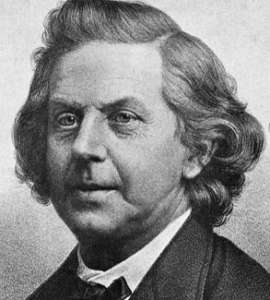
Niels Wilhelm Gade (22 February 1817 – 21 December 1890) was a Danish composer, conductor, violinist, organist, and teacher. He was considered the most important Danish musician of his day.
Gade was born in Copenhagen, the son of a joiner and instrument maker.
He began his career as a violinist with the Royal Danish Orchestra, which premiered his concert overture Efterklange af Ossian (“Echoes of Ossian”) in 1841.
When his first symphony was turned down for performance in Copenhagen, he sent it to Felix Mendelssohn, who received the work positively, and conducted it in Leipzig in March 1843, to an enthusiastic public reaction.
Supported by a Danish government fellowship, Gade moved to Leipzig, teaching at the Conservatory there, working as an assistant conductor of the Gewandhaus Orchestra, and befriending Mendelssohn, who had an important influence on his music.
In 1845 he conducted the premiere of Mendelssohn’s Violin Concerto in E minor.
He also became friends with Robert Schumann and Robert Franz.
 At Mendelssohn’s death in 1847, Gade was appointed to his position as the chief conductor but was forced to return to Copenhagen in the spring of 1848 when war broke out between Prussia and Denmark.
In Copenhagen Gade became acquainted with the composer Cornelius Gurlitt and they remained friends until the latter’s death.
Gade became director of the Copenhagen Musical Society (Musikforeningen), a post he retained until his death.
He established a new orchestra and chorus while settling into a career as Denmark’s most prominent musician.
Under his direction, the Music Society reached its peak.
He also worked as an organist; though he lost the prestigious position of organist at Our Lady’s Church, today’s Copenhagen Cathedral, to Johan Peter Emilius Hartmann, he served in the Holmen Church in Copenhagen from 1850 until his death.
Gade was joint director of the Copenhagen Conservatory with Hartmann (whose daughter he married in 1852) and Holger Simon Paulli.
An important influence on a number of Scandinavian composers, he encouraged and taught Edvard Grieg, Carl Nielsen, Louis Glass, Elfrida Andrée, Otto Malling, August Winding, and Asger Hamerik.
Among Gade’s works are eight symphonies, a violin concerto, chamber music, organ, and piano pieces, and a number of large-scale cantatas, Comala (1846) and Elverskud (1853) among them, which he called “concert pieces” (koncertstykker).
These products embraced post-1848 as works of Romantic nationalism, are sometimes based on Danish folklore.
Apparently, Gade never rated his “Bridal Waltz” (Brudevalsen). It was rescued by August Bournonville in his ballet A Folk Tale (Et folkesagn) and became an essential part of Danish weddings.
Personal life
In 1852 Gade married Emma Sophie Amalie Hartmann, daughter of Johan Peter Emilius Hartmann. He remarried in 1857 after her death. He died in Copenhagen.
Elverskud (The Elf King’s Daughter), op. 30, a ballad for soloist, choir, and orchestra
The ballad is divided into five sections, a prologue, three “acts” and an epilogue.
00:00 – Prologue: Here the scene is set. Sir Oluf has been seduced by some elf-maidens.
03:16 – Part I: On The Eve Of Oluf’s Wedding. The chorus announces that Sir Oluf is to be married, but the situation goes awry when Oluf, to his mother’s amazement, wants to ride out one night. He explains how he is torn between his golden-haired and blue-eyed bride-to-be and the elf king’s daughter, black-haired, bold, and daring. Despite his mother’s warnings, Oluf rides away.
16:43 – Part II: A Moonlit Night At The Fairy Hill. Oluf rides through the dark and ominous forest where he meets the elf-maidens. The Elf King’s daughter urges him to stay, but he refuses. She curses him, but he escapes and rides back home.
28:44 – Part III: In The Morning At Oluf’s Castle. The choir sings “I østen stiger solen op” (“In the east the Sun Rises”) and the mother is worried, but not yet aware of what has happened. As Oluf arrives, it is with death as a companion.
42:50 – Epilogue: The choir sings the short moral that one should stay away from Elverhøj because “the heart is put to sleep.”
In the video, Elverskud is performed by Collegium Musicum, and the Canzone Choir is conducted by Frans Rasmussen. Soloists are Lisbeth Balslev, Soprano (the daughter of the elf king), Edith Guillaume, Mezzosoprano (the mother), and Mikael Melbye, Baritone (Oluf). The recording took place in the Odd-Fellow Palace in Copenhagen, in March 1985.
This video presents a live performance of “I østen stiger solen op” (“In the east the Sun Rises”) by the Trinity Church Choir (Treenighedskirken’s kor) in Esbjerg, Denmark. The conductor is Lone Gislinge. The recording is from a concert in St Mary Magdalene Church in Newark in England in August 2010 on the choir’s annual concert tour.
Overture Echoes of Ossian (Efterklange af Ossian), Op. 1 (1840)
The Overture is based on a cycle of epic poems published by the Scottish poet James Macpherson in 1760.
Macpherson claimed to have collected word-of-mouth material in Gaelic, said to be from ancient sources, and that the work was his translation of that material.
Ossian is based on Oisín, son of Finn or Fionn mac Cumhaill, anglicized to Finn McCool, a legendary bard who is a character in Irish mythology.
Contemporary critics were divided in their view of the work’s authenticity, but the consensus since is that Macpherson framed the poems himself, based on old folk tales he had collected.
In the video, the overture is performed by the Danish National Radio Symphony Orchestra conducted by Dmitri Kitajenko.
Symphony No.1 in C-minor, Op. 5 “On Sjoland’s Fair Plains” (1842)
The movements are:
Mov. I: Moderato con moto – Allegro energico – Con più moto 00:00
Mov. II: Scherzo: Allegro risoluto quasi presto 09:32
Mov. III: Andantino grazioso 15:09
Mov. IV: Finale: Molto allegro ma con fuoco – Molto marcato 23:54
In the video, the symphony is performed by the Danish National Symphony Orchestra conducted by Christopher Hogwood.
–
Symphony No. 2 in E major Op. 10
The movements are:
Andantino quasi allegretto – Molto allegro
Andante con moto
Scherzo: Molto allegro
Finale: Allegro energico
In the video, the symphony is performed by the Danish National Symphony Orchestra conducted by Christopher Hogwood.
Symphony No.3 in A-minor, Op.15 (1847)
The movements are:
Mov. I: Presto 00:00
Mov. II: Andante sostenuto 08:02
Mov. III: Allegretto, assai moderato 13:21
Mov. IV: Finale: Allegro molto e con fuoco 19:32
In the video, the symphony is performed by Orchestra Collegium Musicum in Copenhagen conducted by Michael Schønwandt.
–
Symphony No. 4, Op 20
The movements are:
I. Andantino – Allegro vivace e grazioso
II. Andante con moto
III. Scherzo: Allegro, ma non troppo e tranquillamente
IV. Finale: Allegro molto vivace
In the video, the symphony is performed by the Danish National Symphony Orchestra conducted by Christopher Hogwood.
–
Symphony No.5 in D-minor with solo piano, Op.25 (1852)
The movements are:
Mov. I: Allegro con fuoco 00:00
Mov. II: Andante sostenuto 09:20
Mov. III: Scherzo: Allegro molto vivace 15:52
Mov. IV: Andante con moto – Allegro vivace 20:19
In the video, the symphony is performed by Collegium Musicum, and Amalie Malling (piano) conducted by Michael Schønwandt.
–
Symphony No. 6 in G minor, Op. 32
The movements are:
I. Andantino – Allegro molto vivace 0:00
II. Andante sostenuto 7:00
III. Allegro – moderato e energico 13:16
IV. Finale: Andantino quasi allegretto – Allegro vivace e animato 18:05
In the video, the symphony is performed by Orchestra Collegium Musicum in Copenhagen conducted by Michael Schønwandt.
–
Symphony No. 7 in F Major, Op. 45
The movements are:
I. Allegro risoluto 0:00
II. Andante 10:23
III. Scherzo: Allegro vivace 19:08
IV. Finale: Allegro vivace 23:32
In the video, the symphony is performed by the Danish National Symphony Orchestra conducted by Christopher Hogwood.
–
Symphony No. 8 in B minor, Op. 47
The movements are:
I. Allegro molto e con fuoco 0:00
II. Allegro moderato 8:30
III. Andantino 13:33
IV. Finale: Allegro non troppo e marcato 20:49
In the video, the symphony is performed by the Danish National Symphony Orchestra conducted by Christopher Hogwood.
–
Violin Concerto in D minor, Op. 56
The movements are:
I. Allegro con fuoco 0:00
II. Romanze: Andantino espressivo 11:30
III. Rondo scherzando: Allegro, ma non troppo 18:55
In the video, the concerto is performed by Christina Åstrand, violin with the Tampere Philharmonic Orchestra conducted by John Storgårds.
–
Spring Phantasia / Foraarsfantasi, Op.23, Cantata (1852)
The movements are:
Mov. I: Allegro moderato e sostenuto 00:00
Mov. II: Allegro molto e con fuoco 07:21
Mov. III: Allegro vivace 14:05
In the video the cantata is performed by the Tivoli Symphony Orchestra conducted by Michael Schønwandt. Soloists are: Soprano: Anne Margrethe Dahl, Contralto: Kirsten Dolberg, Tenor: Gert Henning-Jensen, Baritone: Sten Byriel, and Piano: Elisabeth Westenholz.
–
“Baldur’s Dream”, Op. 117 (1856-57, UA 1858), Cantata
No. 1. Introduction Scene (Chorus)
No. 2. — (Brage, Frigge, Chorus)
No. 3. — (Frigge, Baldur, Chorus)
No. 4. — (Baldur, Chorus)
No. 5. — (Chorus, Baldur)
No. 6. — (Chorus)
No. 7. — (Chorus, Frigge)
No. 8. — (Frigge, Chorus)
No. 9. — (Brage, Chorus)
In the video, the cantata is performed by Helsingborg’s Symphony Orchestra and the Canzone choir conducted by Frans Rasmussen. Soloists are Marianne Rørholm – Frigge (soprano), Poul Elming – Baldur (tenor), and Per Høyer – Brage (barytone)
–
Bridal Waltz (Brudevals) from A Folk Tale (Et Folkesagn)
In the video, the bridal waltz is performed by the Royal Danish Orchestra.
–