ECstep
  • Home
    • List Of Pages
  • Copenhagen
    • Parks in Copenhagen
      • Amaliehaven – The Amalie Garden
      • Bibliotekshaven – The Royal Library Garden
      • Botanisk Have – Botanical Garden
      • Christianshavns Vold – Christianshavn’s Rampart
      • Classens Have – Classen’s Garden
      • Frederiksberg Have – Frederiksberg Park
      • Fælledparken – The Common Park
      • Glyptotekshaven – The Glyptotek Garden
      • Havneparken – The Harbour Park
      • Kastellet – The Citadel
      • Kongens Have – The King’s Garden
      • Langelinie – Long Line – The Little Mermaid
      • Skydebanehaven – The Shooting Range Garden
      • Søndermarken – The Southern Park
      • Tivoli – Tivoli Gardens
      • Ørstedsparken – The Ørsted Park
      • Østre Anlæg – Eastern Park
      • Assistens Kirkegård – Assistens Cemetery
      • Holmens Kirkegård – Holmen’s Cemetery
      • Garnisons Kirkegård – Garrison’s Cemetery
  • Nature
    • Natural Patterns
    • Natural Landscapes
    • Sustainability
    • Animals helping humans
  • People
    • Society
      • A Good Society
      • Democracy is good
      • Autocracy is hazardous
      • Female Strengths
      • A Happy Nation
      • Handle conflict
      • Avoid War
      • Religion-free public space
      • Opinions
    • Persons
      • Ted Allbeury
      • Victor Borge
      • Charlie Chaplin
      • Paul Fischer
      • Piet Hein
      • Thor Heyerdahl
      • Tom Lehrer
      • Erich Maria Remarque
  • Art
    • Vibeke’s Artwork
  • Music
    • Classical Music
      • Johann Sebastian Bach
      • Béla Bartók
      • Beethoven
      • Hector Berlioz
      • Alexander Borodin
      • Brahms
      • Claude Debussy
      • Dvořák
      • Niels W. Gade
      • Vagn Holmboe
      • C. F. E. Horneman
      • Kuhlau
      • Mendelssohn
      • Mozart
      • Modest Mussorgsky
      • Carl Nielsen
      • Sergei Prokofiev
      • Giacomo Puccini
      • Sergey Rachmaninoff
      • Knudåge Riisager
      • Nikolai Rimsky-Korsakov
      • Schubert
      • Schumann
      • Shostakovich
      • Igor Stravinsky
      • Tchaikovsky
      • Carl Maria von Weber
      • C. E. F. Weyse
    • Jazz
      • Buddy DeFranco
      • Stan Getz
      • Benny Goodman
      • Niels-Henning Ørsted Pedersen (NHØP)
      • Oscar Peterson
      • George Shearing
      • Art Tatum
  • Finance
  • Nutrition
    • Nutrient Classes
      • Protein
      • Amino Acids
      • Fat
      • Carbohydrate
      • Vitamins
      • Minerals
      • Dietary Fiber
      • Water
      • Weight Control
    • Nutrient rich foods
      • Vitamin A – retinol – rich foods
      • Choline – vitamin Bp – rich foods
      • Vitamin B1 – thiamin – rich foods
      • Vitamin B2 – riboflavin – rich foods
      • Vitamin B3 – niacin – rich foods
      • Vitamin B5 – pantothenic acid – rich foods
      • Vitamin B6 – pyridoxine – rich foods
      • Folic Acid – vitamin B9 – rich foods
      • Vitamin B12 – cobalamin – rich foods
      • Vitamin C – ascorbic acid – rich foods
      • Vitamin D – calciferol – rich foods
      • Vitamin E – tocopherol – rich foods
      • Vitamin K – phylloquinone – rich foods
      • Calcium rich foods
      • Copper rich foods
      • Iron rich foods
      • Magnesium rich foods
      • Manganese rich foods
      • Phosphorus rich foods
      • Potassium rich foods
      • Selenium rich foods
      • Sodium rich foods
      • Zinc rich foods
      • Histidine rich foods
      • Isoleucine rich foods
      • Leucine rich foods
      • Lysine rich foods
      • Methionine rich foods
      • Phenylalanine rich foods
      • Threonine rich foods
      • Tryptophan rich foods
      • Valine rich foods
      • Alpha-Linolenic Acid (ALA) rich foods
      • Docosahexaenoic Acid (DHA) rich foods
      • Eicosapentaenoic Acid (EPA) rich foods
      • Linoleic Acid (LA) rich foods
  • Compute
    • Statistics
      • 1. Types of Data
      • 2. The Normal Distribution
      • 3. Confidence Interval
      • 4. Testing a Hypothesis
      • 5. Sample Size Determination
      • 6. Statistical Tests
      • 7. Survival Analysis
      • 8. Correlation and Regression Analysis
      • 9. Probability Distributions
      • 10. Diagnostic Tests
      • 11. Meta-analysis
      • 12. Neural Network
    • Source Code
      • EC Codes in PowerBasic Forum
      • Beta Function
      • Chi-square Distribution
      • F-distribution
      • Gamma Function
      • Matrix Inversion
      • Normal Distribution
      • t-distribution
    • Programs
      • Neural Network Program
      • Personal Nutrition Program
      • Sudoku Instructions Program
      • Meta-Analysis Program
  • About EC
    • Contact
  • Click to open the search input field Click to open the search input field Search
  • Menu Menu
  • Foods rich in Vitamin A (Retinol) (top)
  • Beta-carotene
  • Alpha-carotene
  • Beta-cryptoxanthin

Vitamin A (retinol) rich foods

4.6/5 (5)

Vitamin A (retinol) is a fat-soluble vitamin that is present in many foods from animal sources, including dairy products, fish, and meat (especially liver).

The vitamin is important for normal vision, the immune system, and reproduction and also helps the heart, lungs, kidneys, and other organs work properly. More on vitamin A here.

Beta-carotene, alpha-carotene, and beta-cryptoxanthin are provitamins, which are transformed in the body into vitamin A. These provitamins are found in fruits, vegetables, and other plant-based products.

The average daily recommended amount of vitamin A in micrograms (mcg or μg) of retinol activity equivalents (RAE) depends on your age and gender being 700 mcg for adult females and 900 mcg for adult males. Children need smaller amounts.

Below is a list of foods having the highest content of vitamin A in micrograms (μg) per 100 grams of the food. The list also includes the number of kilocalories (kcal) and the vitamin A content in micrograms (μg) per kcal, and the list is sorted with respect to the latter with the highest values at the top.

As you can see there are many foods having a high vitamin A content per kcal. So if you are lacking in vitamin A, you could easily correct the deficiency by eating some of these foods. Rather small amounts should be sufficient in most cases.

You should remember that vitamin A can be toxic if very large amounts are ingested repeatedly.

The list is made using ECstep’s Personal Nutrition Data Program and includes more than 100 of the vitamin A richest foods.  Commercial brand products are not included in this list.
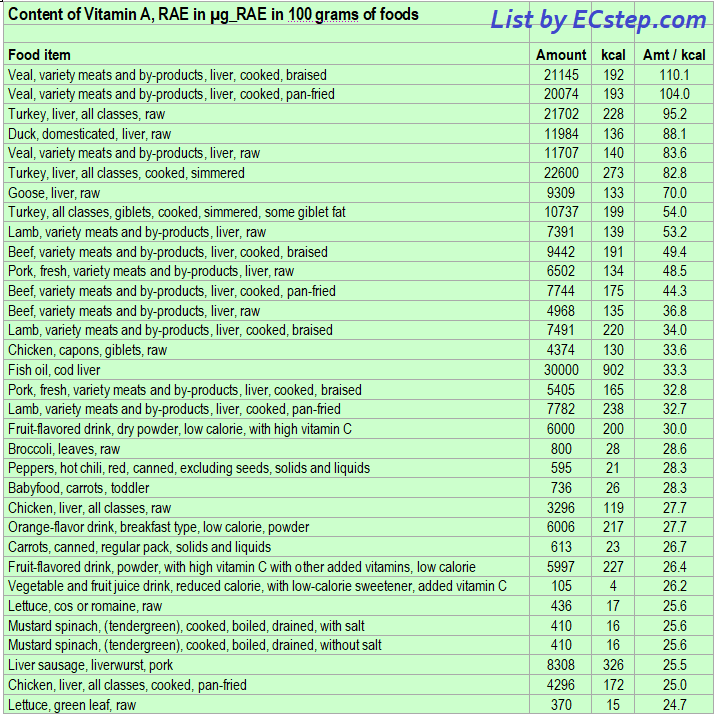
Vitamin A rich foods ranked according to amount/kcal part 1Vitamin A rich foods ranked according to amount/kcal part 2Vitamin A rich foods ranked according to amount/kcal part 3

–

Beta-carotene rich foods

Beta-Carotene is an organic, strongly colored red-orange pigment abundant in fungi, plants, and fruits. It is the most common form of carotene in plants and a precursor to vitamin A.

Excess beta-carotene is predominantly stored in the fat tissues of the body.

The most common side effect of excessive beta-carotene consumption is carotenoderma, a harmless condition that presents as a conspicuous orange skin tint arising from the deposition of the carotenoid in the skin.

Carotenodermia is quickly reversible upon cessation of excessive intake.

The proportion of carotenoids absorbed decreases as dietary intake increases.

Within the intestinal wall, beta-carotene is partially converted into vitamin A.

This mechanism is regulated by the vitamin A status.

If the body has enough vitamin A, the conversion of beta-carotene decreases.

Therefore, beta-carotene is a safe source of vitamin A and high intakes will not lead to vitamin A toxicity.

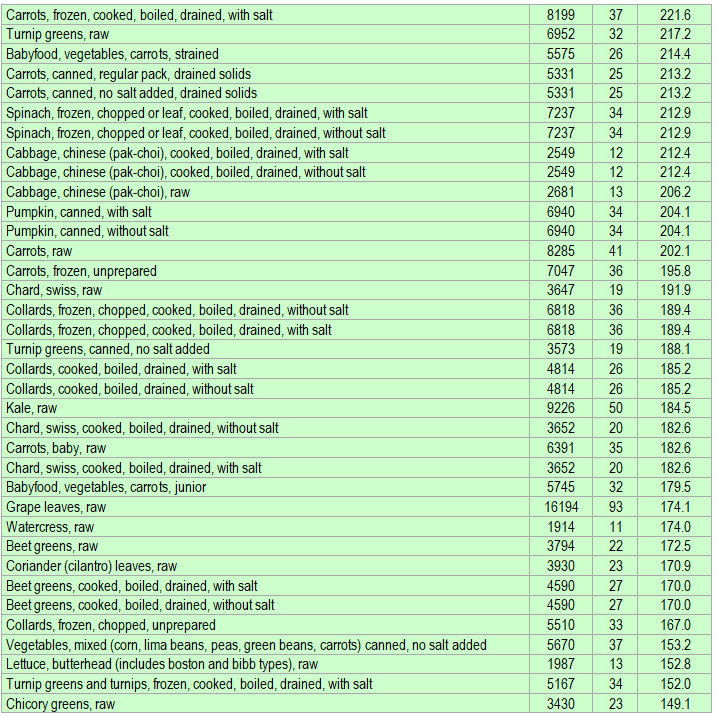
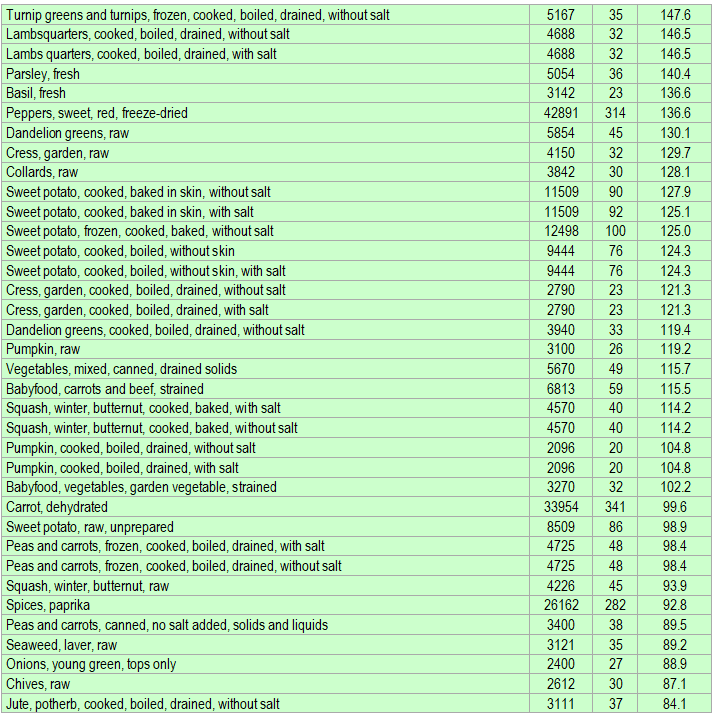
Below is a list of foods having the highest content of beta-carotene in micrograms (μg) per 100 grams of the food. The list also includes the number of kilocalories (kcal) and the beta-carotene content in micrograms (μg) per kcal, and the list is sorted with respect to the latter with the highest values at the top.

The list is made using ECstep’s Personal Nutrition Data Program and includes more than 100 of the beta-carotene richest foods.  Commercial brand products are not included in this list.
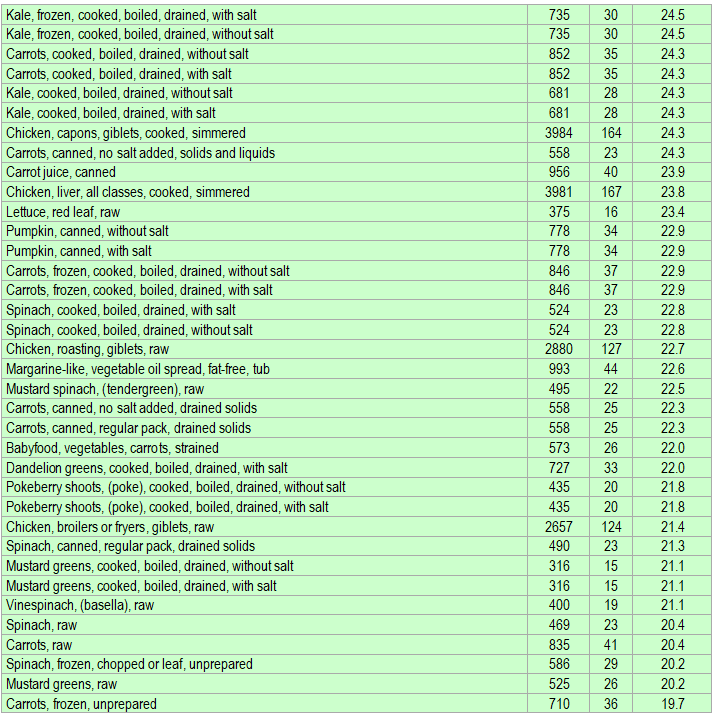
Beta-carotene rich foods ranked according to amount/kcal part 1Beta-carotene rich foods ranked according to amount/kcal part 2Beta-carotene rich foods ranked according to amount/kcal part 3

–

Alpha-carotene rich foods

Alpha-carotene is another carotenoid that also has provitamin A activity.

Like other carotenoids, it has antioxidant and possibly anti-carcinogenic properties, and may enhance immune function as well.

Some studies have found that higher alpha-carotene intake is associated with a lower risk of cardiovascular disease and cancer.

Alpha-carotene is usually associated with ample amounts of beta-carotene when found in fruits and vegetables.

Alpha-carotene’s concentration is especially high in orange carrots and high serum concentrations are associated with carrot intake.

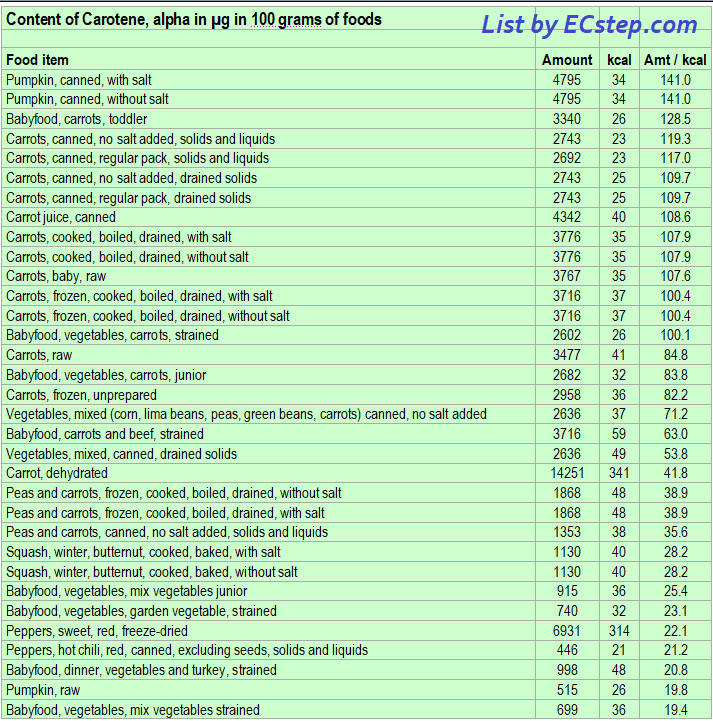
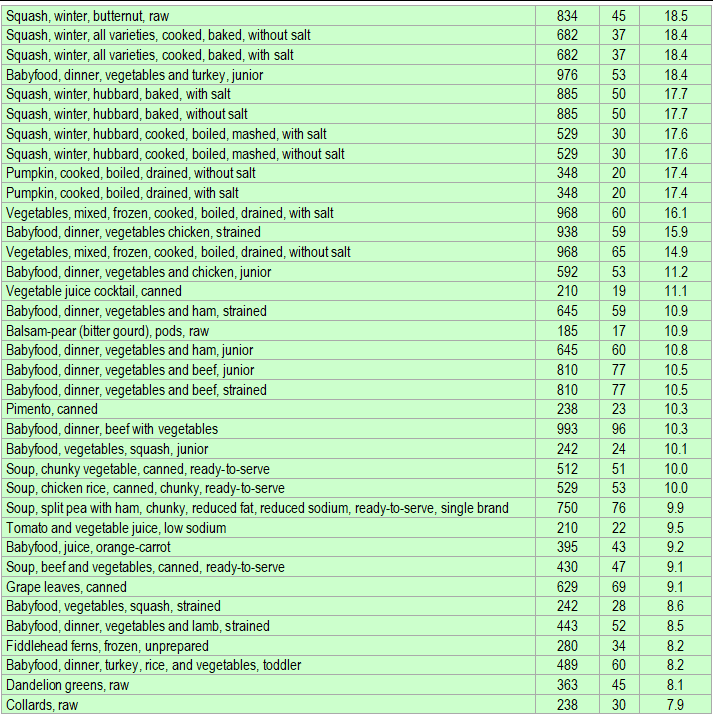
Below is a list of foods having the highest content of alpha-carotene in micrograms (μg) per 100 grams of the food. The list also includes the number of kilocalories (kcal) and the alpha-carotene content in micrograms (μg) per kcal, and the list is sorted with respect to the latter with the highest values at the top.

The list is made using ECstep’s Personal Nutrition Data Program and includes more than 100 of the alpha-carotene richest foods.  Commercial brand products are not included in this list.
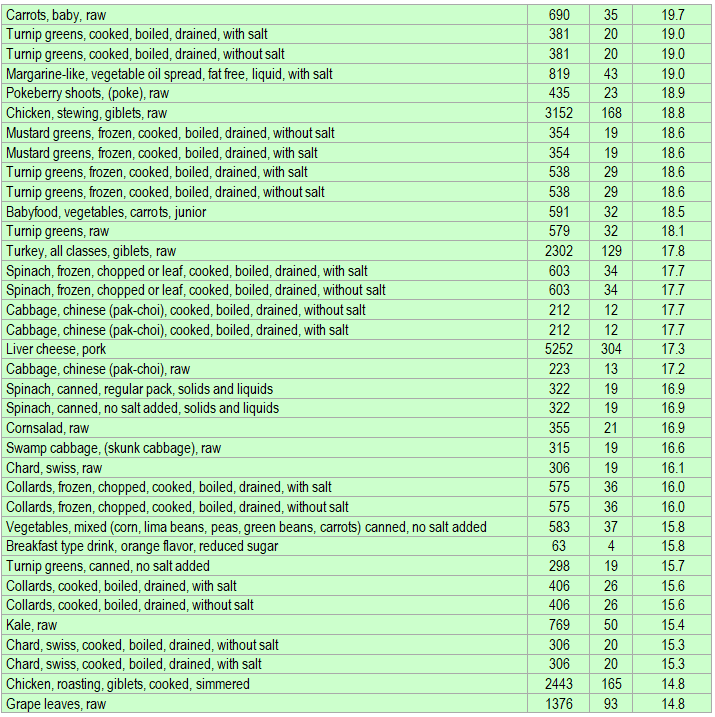
Alpha-carotene rich foods ranked according to amount/kcal part 1Alpha-carotene rich foods ranked according to amount/kcal part 2Alpha-carotene rich foods ranked according to amount/kcal part 3

–

Beta-cryptoxanthin rich foods

Beta-cryptoxanthin is a natural carotenoid pigment, which is closely related to beta-carotene. It is a member of the class of carotenoids known as xanthophylls.

In the human body, beta-cryptoxanthin is converted to vitamin A and is, therefore, considered a provitamin A.

As with other carotenoids, beta-cryptoxanthin is an antioxidant and may help prevent free radical damage to cells and DNA.

Recent findings of an inverse association between beta-cryptoxanthin and lung cancer risk in several observational epidemiological studies suggest that beta-cryptoxanthin could potentially act as a chemopreventive agent against lung cancer.

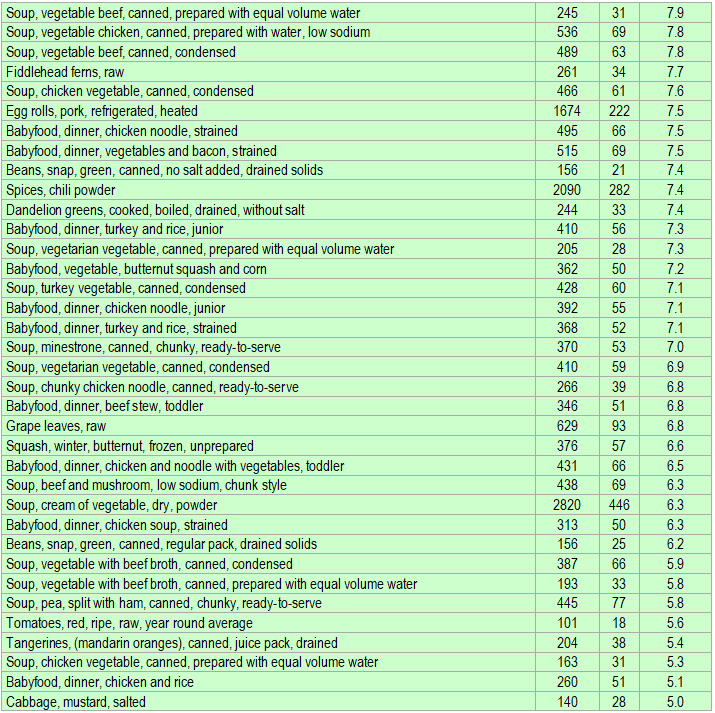
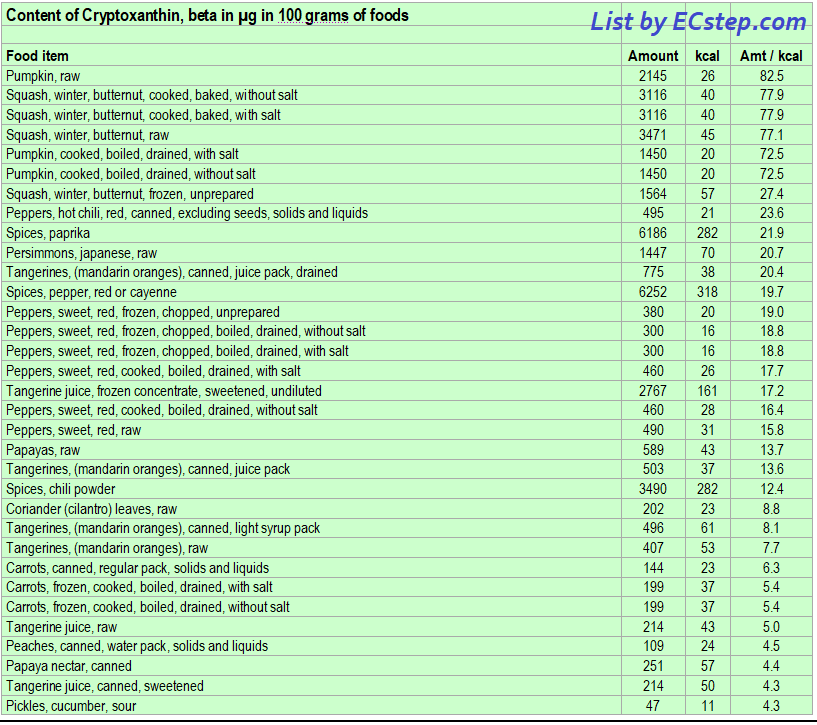
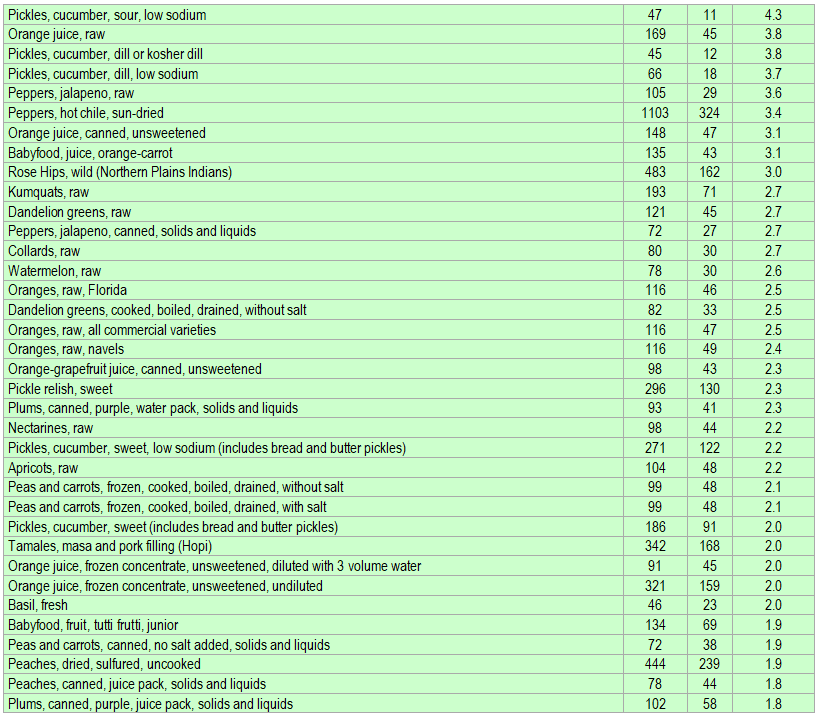
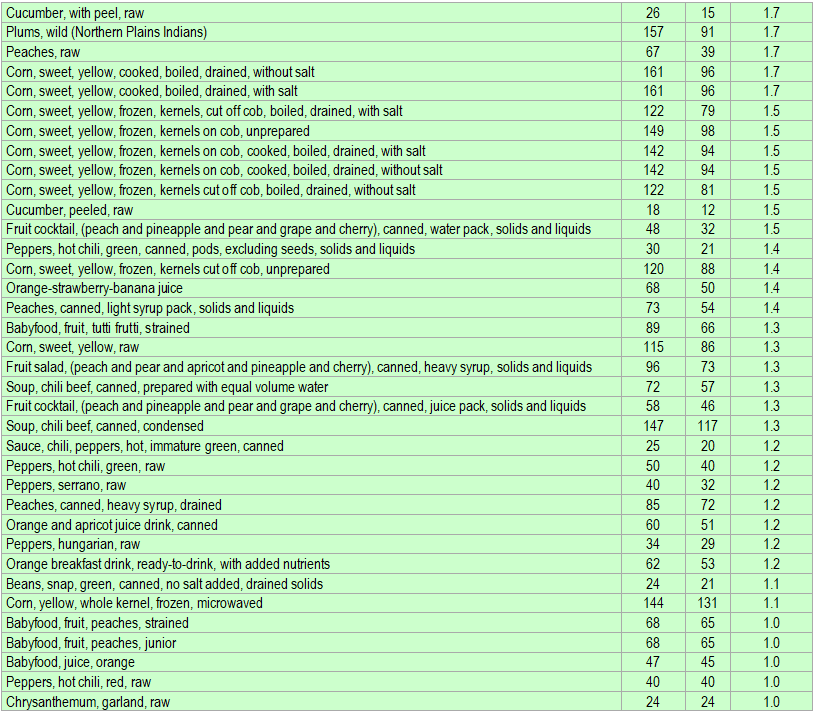
Below is a list of foods having the highest content of beta-cryptoxanthin in micrograms (μg) per 100 grams of the food. The list also includes the number of kilocalories (kcal) and the beta-cryptoxanthin content in micrograms (μg) per kcal, and the list is sorted with respect to the latter with the highest values at the top.

The list is made using ECstep’s Personal Nutrition Data Program and includes more than 100 of the beta-cryptoxanthin richest foods.  Commercial brand products are not included in this list.
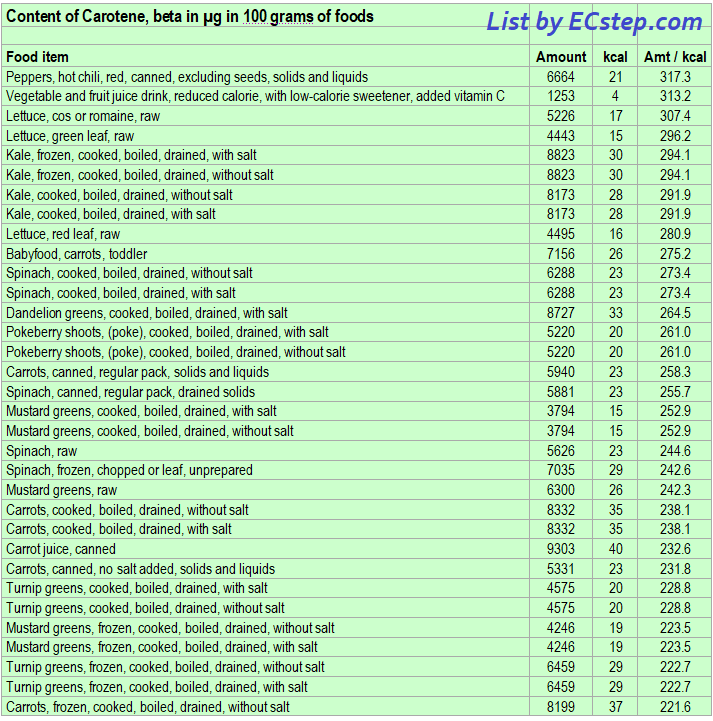
Beta-cryptoxanthin rich foods ranked according to amount/kcal part 1Beta-cryptoxanthin rich foods ranked according to amount/kcal part 2Beta-cryptoxanthin rich foods ranked according to amount/kcal part 3

Please Rate This Page

Super Sudoku Instructions Program For You

Sudoku Instructions Program by ECstep.com

The Best Nutrition Program For You – protein, carb, fat, vitamins, minerals, fiber

List of Nutrients in 8 ounces of creamed cottage cheese with fruit displayed using ECstep's Personal Nutrition Data Program

Modern graphical art for you for sale online

Vibeke's Artwork

Use the information in your data with this Neural Network Program

ECstep Neural Network

Here is a very fine Meta-Analysis Program for you

Meta-Analysis Program by ECstep


© Copyright: ECstep, Copenhagen, Denmark --- All Rights Reserved ---Go to top --- CONTACT FORM ---------
Send email Mail
Print Print
- Enfold Theme by Kriesi
Scroll to top Scroll to top Scroll to top

Pin It on Pinterest

  • …
  • …
  • …
  • …
Verified by ExactMetrics
Verified by MonsterInsights