
Franz Schubert
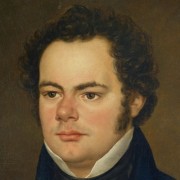 Franz Peter Schubert (31 January 1797 – 19 November 1828) was an Austrian composer who died at 31 but was extremely prolific during his lifetime.
His output consists of over six hundred secular vocal works (mainly Lieder), seven complete symphonies, sacred music, operas, incidental music, and a large body of chamber and piano music.
Appreciation of his music, while he was alive, was limited to a relatively small circle of admirers in Vienna, but interest in his work increased significantly in the decades following his death.
Felix Mendelssohn, Robert Schumann, Franz Liszt, Johannes Brahms, and other 19th-century composers discovered and championed his works. 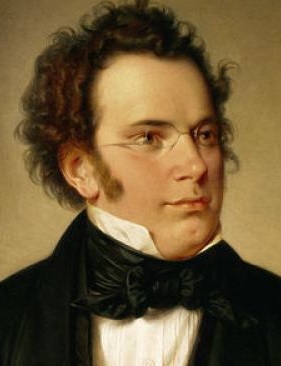
Today, Schubert is ranked among the greatest composers of the late Classical era and early Romantic era and is one of the most frequently performed composers of the early nineteenth century.
Aged 10, the young Schubert won a place in the Vienna Imperial Court chapel choir and quickly gained a reputation as a budding composer with a set of facile string quartets.
After leaving chapel school and having completed the year’s mandatory training, Schubert followed his father into the teaching profession.
This was at once a calamitous move and a blessing, for it was Schubert’s deep loathing of the school environment that finally lit the touchpaper of his creative genius.
The same year he began teaching – 1814 – he produced his first indisputable masterpiece, ‘Gretchen am Spinnrade’ (‘Gretchen at her spinning wheel’).
At the age of 18, while he was still struggling to hold down his full-time teaching post, he not only composed 145 lieder (songs) – including the unforgettable ‘Erlkonig’ – the Second and Third Symphonies, two sonatas, and a series of miniatures for solo piano, two mass settings and other shorter choral works, four-stage works, and a string quartet, in addition to various other projects.
This period of intense creative activity remains one of the most inexplicable feats of productivity in musical history.
Musical soirees known as Schubertiads became all the rage, during which Schubert might sing some of his own songs while accompanying himself at the piano.
With little money and nothing much more than his ‘groupies’ to support him, Schubert began to produce a seemingly endless stream of masterpieces that for the most part were left to prosperity to discover, including the two great song cycles, Die Schone Mullerin and Winterreise, the Eighth (‘Unfinished’) and Ninth (‘Great’) Symphonies, the Octet for Wind, the last three string quartets, the two piano trios, the String Quintet, the ‘Wanderer’ Fantasy and the last six sonatas for solo piano.
–
–
–
Symphony No. 1 in D major, D. 82
This symphony was composed by Franz Schubert in 1813 when he was just 16 years old. Despite his youth, his first symphony is an impressive piece of orchestral music for both its time and size. The first movement opens with a stately Adagio introduction, reminiscent of Joseph Haydn’s 104th symphony in its format. The short Adagio sets off a lively Allegro vivace.
The standard four-movement work runs about 26 minutes.
Adagio — Allegro vivace
Andante in G major
Menuetto. Allegro
Allegro vivace
In the video, the symphony is performed by Camerata Academica des Mozarteums Salzburg conducted by Sandor Vegh. From “Serenadenkonzert der Salzburger Festspiele 1988” Der Aula der Alten Universitat, Salzburg. This is a very fine performance by one of the very best chamber orchestras in the world.
–
–
–
Symphony No. 2 in B♭ major, D. 125
This symphony was composed between 1814 and 1815. n the opening movement, the initial theme of the Allegro vivace is based on the corresponding first theme of Ludwig van Beethoven’s overture to The Creatures of Prometheus.
The second movement is a theme with five variations in E♭ major, Schubert’s only set of symphonic variations. Although there is some variation in the melody, the primary focus of the variations is on instrumentation and tone color.
There are four movements:
Largo — Allegro vivace
Andante in E♭ major
Menuetto: Allegro vivace in C minor — Trio in E♭ major
Presto
In the video, the symphony is performed by the Bavarian Radio Symphony Orchestra conducted by Lorin Maazel.
–
–
–
Symphony No. 3 in D major, D. 200
This symphony was written between 24 May and 19 July 1815, a few months after his eighteenth birthday. Like the other early symphonies, it was not published during Schubert’s lifetime. It just appeared many years later, in the first Schubert complete works edition in 1884.
The length of this symphony is approximately 21–23 minutes. It is in four movements:
I. Adagio maestoso – Allegro con brio
II. Allegretto in G major
III. Menuetto. Vivace
IV. Presto vivace
In this video, the symphony is performed by the Frankfurt Radio Symphony Orchestra conducted by Andrés Orozco-Estrada.
Symphony No. 4 in C minor, D. 417
This symphony, commonly called the Tragic, was composed in April 1816 when Schubert was 19 years old. However, the work was premiered only on November 19, 1849, in Leipzig, more than two decades after Schubert’s death. The title Tragic is Schubert’s own. It was added to the autograph manuscript sometime after the work was completed. It is not known exactly why he added the title, but the work is one of only two symphonies (the Unfinished Symphony is the other) that Schubert wrote in a minor key.
There are 4 movements:
1. Adagio molto – Allegro vivace
2. Andante in A flat major
3. Menuetto. Allegro vivace – Trio
4. Allegro
In the video, the symphony is performed by the Orchestre de Paris conducted by Louis Langrée.
Symphony No. 5 in B flat major, D. 485
This was completed on October 3, 1816 – six months after the completion of his previous symphony.
In character, the writing is often said to resemble Mozart; Schubert was infatuated with the composer at the time he composed it. This is reflected particularly in the lighter instrumentation. Indeed, the instrumentation matches that of the first version (without clarinets) of Mozart’s 40th symphony.[
There are four movements:
00:00 – Allegro
07:40 – Andante con moto
18:04 – Menuetto. Allegro molto
23:33 – Allegro Vivace
In the video, the symphony is performed by NHK Symphony Orchestra conducted by Junichi Hirokam.
Symphony No. 6 in C major, D. 589
This was composed between October 1817 and February 1818. Its first public performance was in Vienna in 1828. It is nicknamed the “Little C major” to distinguish it from his later Ninth Symphony, in the same key, which is known as the “Great C major”.
There are four movements:
Adagio, – Allegro
Andante
Scherzo: Presto; Trio: Piu lento
Allegro moderato
In the video, the symphony is performed by Frankfurt Radio Symphony Orchestra conducted by Antonello Manacorda.
Symfoni No. 7 in E major, D. 729
This was drafted in August 1821. Although the work (which comprises about 1350 bars is structurally complete, Schubert only orchestrated the slow introduction and the first 110 bars of the first movement. The rest of the work is, however, continued on 14-stave score pages as a melodic line with occasional basses or counterpoints, giving clues as to changes in the orchestral texture.
There are 4 movements:
1st mvt. Adagio Allegro..00:00
2nd mvt. Andante……….12:00
3rd mvt. Scherzo. Trio….20:50
4th mvt. Allegro giusto…27:20
In the video, the symphony is performed by the Danish National Symphony Orchestra conducted by Andrew Manze.
Symphony No. 8 in B minor, D.759
This is commonly known as the “Unfinished Symphony”. It is a work that Schubert started in 1822 but left with only two movements—though Schubert lived for another six years. A scherzo, nearly completed in piano score but with only two pages orchestrated, also survives.
The symphony was not premiered until 1865 after Schubert had already been dead for 37 years. Even the premiere was a sensational success, and to this day the “Unfinished” is an absolute favorite with audiences.
It is considered the first “Romantic” symphony ever because it contains much that is musically new.
It’s opening alone, with the mysterious and almost threatening ascending and descending melody in the low strings, builds up a tension that is maintained until the end of the two movements.
Both movements are similar not only in tempo but also in structure. Somber, ominous passages are followed by sultry, homely ländler, which in turn break off abruptly, so that positive melodic lines always prove deceptive.
Although the second movement seems more optimistic overall, the thematic blocks always take unexpected turns. But still, the symphony fragment ends in a kind of chorale in which the conflicting themes are reconciled.
The two movements are:
(00:00) I. Allegro moderato
(15:00) II. Andante con moto
This video presents a wonderful performance of the symphony by the Budapest Festival Orchestra conducted by Iván Fischer.
Symphony No. 9 in C major, D. 944
This symphony is known as the Great. It is the final symphony completed by Franz Schubert. Originally called The Great C major to distinguish it from his Symphony No. 6, the Little C major,
There are four movements:
1 Andante – Allegro ma non troppo
2 Andante con moto
3 Scherzo. Allegro vivace – Trio
4 Finale. Allegro vivace
In the video, the symphony is performed by the Wiener Philharmoniker conducted by John Eliot Gardiner.
Octet in F major, D. 803
This was composed by Franz Schubert in March 1824. It was commissioned by the renowned clarinetist Ferdinand Troyer and came from the same period as two of Schubert’s other major chamber works, the ‘Rosamunde’ and ‘Death and the Maiden’ string quartets.
Consisting of six movements, the Octet takes almost an hour to perform.
0:00 Adagio – Allegro – Più allegro
15:33 Adagio
27:37 Allegro vivace – Trio – Allegro vivace
34:29 Andante – variations. Un poco più mosso – Più lento
46:01 Menuetto. Allegretto – Trio – Menuetto – Coda
52:51 Andante molto – Allegro – Andante molto – Allegro molto
The video shows the performance at the International Chamber Music Festival in Utrecht in 2015. The musicians are: Janine Jansen [violin], Gregory Ahss [violin], Nimrod Guez [viola], Nicolas Altstaedt [cello], Rick Stotijn [double bass], Andreas Ottensamer [clarinet], Fredrik Ekdahl [bassoon] and Radek Barborák [french horn]. All these musicians are superb and the performance is outstanding.
Piano Quintet in A major, D. 667 – The Trout Quintet
The piano quintet was composed in 1819 when Schubert was 22 years old; it was not published, however, until 1829, a year after his death. Rather than the usual piano quintet lineup of piano and string quartet, the Trout Quintet is written for piano, violin, viola, cello, and double bass.
The quintet has five movements:
0:08 – I. Allegro Vivace
12:50 – II. Andante in F major
19:34 – III. Scherzo: Presto
24:00 – IV. Andantino – Allegretto in D major
31:34 – V. Allegro giusto
In the video the quintet is performed by Juhani Lagerspetz, Sini Simonen, Steven Dann, Franz Ortner and Michael Seifried at the 15th Esbjerg International Chamber Music Festival 2013. 25th August at South Denmark’s Music Academy, SMKS, Esbjerg.
Here is a video of another fine performance from Berlin Philharmonie Kammermusiksaal. Violin, Noah Bendix-Balgley (1st Concertmaster Berliner Philharmoniker) Viola, Máté Szűcs (1st Principal Viola Berliner Philharmoniker) Cello, Bruno Delepelaire (1st Principal Cello Berliner Philharmoniker) Double bass, Matthew McDonald (1st Principal Double Bass Berliner Philharmoniker) Piano, Yannick Rafalimanana. 1. Allegro vivace 2. Andante 14:30 3. Scherzo: presto 21:36 4. Andantino – Allegretto 26:02 5. Allegro giusto 34:01